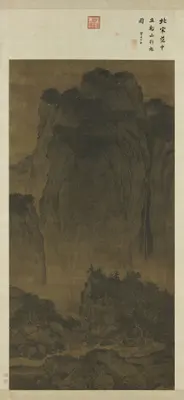
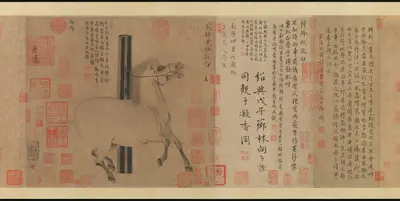
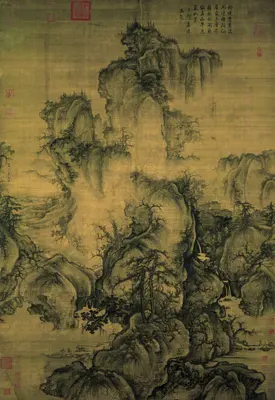
Low hills, pines, riverbanks and villages unroll along more than six metres of paper in dry, layered strokes and pale ink washes. Huang Gongwang worked on the scroll for several years, around the age of eighty, near the Fuchun River. In 1650 a dying owner had it thrown on the fire; it survived in two pieces, reunited only briefly in 2011.
Look closer
At the end of the scroll Huang's own inscription dedicates it to his Daoist friend Wuyong. Four centuries later the Qianlong Emperor dismissed this original as a fake.
Looks like this
Compared by a vision model