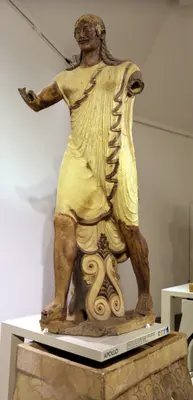
Striding forward in a clinging tunic and short cloak, the god once stood about twelve metres up on the roof of the Portonaccio temple at Veii, disputing the golden-horned hind with Heracles. Life-size and fired in one piece, it is often attributed to Vulca, the only Etruscan artist known by name, or his workshop. Its discovery in 1916 changed how Etruscan art was valued.
Look closer
Note the archaic smile and the long spiralling curls tied with a ribbon. The reddish-brown skin follows the convention for male figures in Greek and Etruscan art.
Looks like this
Compared by a vision model